
The Making of ‘Hong Kong Garden’

Carol Clerk, Uncut, May 2008

The oddly light debut smash that shoved punk’s dark primitives out of the shadows

YOU COULD BE forgiven for thinking that the local Chinese restaurant is an innocuous subject for a song — particularly during the insurrectionist sloganeering of punk. But Siouxsie and the Banshees’ first single attracted its own share of controversy.

Lyrics like “Slanted eyes greet the bright sunrise, a race of bodies small in size...” met with accusations of racism, exacerbated by Siouxsie’s predilection for wearing swastikas on stage at the earliest shows. In fact, nothing could have been further from the truth: visiting her local takeaway in southeast London, Siouxsie now recalls “being really upset by the skinheads who gave the staff such a hard time”.

After two years hunting for a record deal, Polydor signed the Banshees after hearing ‘Hong Kong Garden’ on a Peel session. Incredibly, they found themselves booked into Olympic Studios with US soul producer Bruce Albertine. Rejecting Albertine’s version of ‘Hong Kong Garden’, they regrouped at the Fallout Shelter in the basement of Island Records, with producer Steve Lillywhite, who subsequently produced the band’s debut album, The Scream. ‘Hong Kong Garden’ reached No 7 in the charts — “It should have been higher!” claims bassist Steven Severin. But at least, admits Siouxsie, “it paved the way for us to do what we wanted…”

Siouxsie Sioux — vocalist, lyricist

When ‘Hong Kong Garden’ came out, it surprised a lot of people as it definitely did have a lightness to it. Our material was always a bit heavier. But we loved great pop songs and when John McKay came up with the intro it was very quickly pounced on by all of us.

I’d always been really attracted to Eastern imagery and sound. The story is that when l was growing up, the first Chinese takeaway that went to Chislehurst was called the Hong Kong Garden. I used to go along with my friend and just be really upset by the local skinheads that hung out there and gave the staff such a hard time — really racist, just intolerant. The Avengers was on TV around that time, and I remember us both wishing we were Emma Peel — go in there and sort them out.

The production didn’t allow the song to breathe, originally, with Bruce. Steve Lillywhite brought a lot of space and lightness, with that undercurrent of the band behind it pummelling away.

We didn’t know how much of a chance it would get, in terms of being played on the radio. We’d spent so long getting signed, it seemed like the industry was against us. The Pistols had had their single [‘God Save The Queen’] disallowed from being No 1. There was a controversy about how much punk rock would be tolerated in the charts. But the song was so accessible it opened the door for us. lt enabled us to carry on in the way we wanted with the album. If ‘Hong Kong Garden’ hadn’t been a success, I don’t know how much we would’ve been left to our own devices. It paved the way for us to do what we wanted. Polydor wanted it on The Scream, but because we felt that it was pretty standalone, we insisted that it not be on the album.

Singing it now on stage is quite surreal — it’s been so long — but very refreshing in another way.

John McKay — guitarist, co-writer

‘Hong Kong Garden’ was one of the songs I had in progress before I joined The Banshees. It started life as a song called ‘People Phobia’. I recorded a version, complete with overdubbed guitars and vocals, using two cassette tape recorders, in my bedroom. I played it to the band on the tour bus when we were supporting The Heartbreakers in 1977. Then I presented the song at rehearsals ready to have lyrics and other instruments added.

I first picked out the opening bars of ‘Hong Kong Garden’ on an electronic xylophone in the Maida Vale Peel studio. I played it with the wrong end of the beater and the xylophone switched off, to achieve the right sound.

At Olympic, we were using Eric Clapton’s downtime. Bruce Albertine was an amiable American from the wrong musical tradition, and ‘Hong Kong Garden’ didn’t get out of there alive. We felt at home with Steve Lillywhite, and the studio was more intimate. He recorded us as we were. He was lively, standing to work the controls instead of lounging in the “producer’s chair”, and able to transfer the fire in our performance on to tape. We all had a strong idea of how the song should sound, and all contributed.

We needed to put ‘Hong Kong Garden’ out quickly after a long time without a record deal. We wanted a successful single, but on our own terms. We refused Top Of The Pops. We weren’t gagging for celebrity — we were a gang producing a sound we loved. We were ready to embrace success to promote what we felt was the best group in the world. We were excited — this was our first step out of the crucible of revolution into the treacherous world of the mainstream! We were going overground…

Steven Severin — bassist, co-writer

We were finding our feet not only as songwriters, but as musicians. McKay would bring in to rehearsal a chord sequence that he liked, but nothing you could call a full-fledged song. We would then workout our own parts and start arranging everything. Even though Siouxsie and I started the band in 1976 we felt it was important to credit everyone equally —it was very much in the spirit of “all for one and one for all”. No one was happy with the Olympic session. We found it difficult being so far apart from each other, isolated in booths. We’d never recorded like that. We were used to hearing each other in close proximity and loud, not through headphone mixes. It was very disconcerting.

‘Hong Kong Garden’ wasn’t written as a single, but it was the catchiest thing we’d written thus far. We grew up with our favourite singles not being on albums — ‘Virginia Plain’, ‘Pyjamarama’, ‘John, I’m Only Dancing’, ‘Jumpin’ Jack Flash’ — and that was a precedent we were keen to follow, not least because we felt ‘Hong Kong Garden’ was a sore thumb compared to the material that was being honed for The Scream. Once I heard the final mix, I knew it was a hit.

Oh, it was a great feeling, after slogging around the UK for two years on blind faith and little else. We felt supremely vindicated and actually a bit pissed off it didn’t get higher! We had an intense and righteous belief in ourselves and what we were starting to create. We planned to be there for the long haul, to make a difference… and some of us were and did.

The version of ‘Hong Kong Garden’, and its use in [Sofia Coppola’s] film Marie Antoinette is magnificent. I’d heard a rumour that Sofia was a fan but nothing prepared me for the orchestrated intro. Brilliant.

Steve Lillywhite — producer

It starts with Johnny Thunders. I’m in the studio with him recording So Alone, and Johnny is friends with Nils Stevenson, who was Siouxsie’s manager. Nils came to the studio and liked what he was hearing.

He said they’d recorded a version of ‘Hong Kong Garden’ but didn’t think it was good enough. Did I want to have a go at it? I thought, ‘Wow!’ The vibe was so big with Siouxsie and the Banshees, it felt like it was going to happen. I said let’s do it without having heard it. It wasn’t so much about the song, it was about the movement — punk was really cooking — and I was at the epicentre of the whole thing.

We recorded it at the Fallout Shelter at Island Records in maybe a couple of days. There were other bands around whose interest was more in getting loaded and having a party, whereas with Siouxsie and the Banshees, it was art.

In those days, we were serious about not liking to spend too long on songs. I would never let guitar players bend a note. The moment you bent a note, it was considered like Pink Floyd — the ‘bad stuff’. I remember getting Kenny Morris to play his drums separately so not to hit the cymbals at the same time, which is something that l’ve done a lot.

‘Hong Kong Garden’ was recorded to be a single. Lt was also a test to see whether we would get on, to be able to do the album. It was my first hit. I’m very proud of it. It sounds even better now than it did then. Some records in your career you think are good and are hits, but just sort of die, and others have a life of their own, and ‘Hong Kong Garden’ does a little bit of that.

Kenny Morris — drummer, co-writer

There were four people in a band who could not be more compatible, who were absolutely perfect — the four of us. I thought at the time that our best song was ‘Love ln A Void’ and that it should be the firsts ingle, but our manager decided on ‘Hong Kong Garden’ because the very first few seconds that you hear on the radio or driving in a car, you’re hooked straight away. Everybody loved it. That was a good decision by Nils Stevenson, because much of our music was very dark and this was a way of bringing people in to listen to our album.

I remember we played the Roundhouse [July 23,1978], We’d only recently signed to Polydor, but ‘Hong Kong Garden’ had been broadcast ton the John Peel show. We went to the Roundhouse and there were absolutely hundreds and hundreds of people there. I said to John McKay, “Who are all these people?” They were there to see Siouxsie and the Banshees. All of a sudden, there it was, No. 7 in the charts. We were catapulted into the bigtime. Big concerts. You never had to have a penny in your pocket. Wherever you went, people would throw anything at you, whatever you wanted.

© Carol Clerk, 2008
Siouxsie Sioux who R U?: Siouxsie & the Banshees

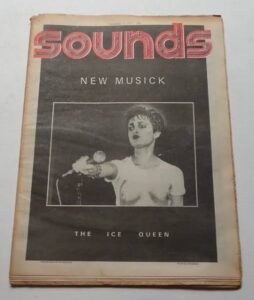
Vivien Goldman, Sounds, 3 December 1977

PREMISE: Record company executives have been skipping the brandy on their expense account lunches in their eagerness to sign up any band that can loosely be defined as “punk”.

FACT: Siouxsie & the Banshees are certified members of the advance guard of the New Wave – their first gig was at the 100 Club’s legendary Punk Fest a year ago.

FACT: Siouxsie & the Banshees hold the house attendance record at the Vortex on the club’s second night.

FACT: Siouxsie & the Banshees have not been offered any record deals.

POSTULATE: Who are these people? Stepping razors or what? They must be dangerous…(“EMI said they’d take us on if they could control our lyrics.” – Steve Banshee)

“They’re so ignorant. Look at all these arseholes that are signed up, that’s proof. I consider it a compliment in a way, but – I just don’t know why…” – Siouxsie Sioux*

ANYONE WHO READS the rock press – and that means you, fellow fan – can come up with a couple of reasons why Siouxsie & the Banshees are the last interesting unsigned band. When it comes to Bad Press, this outfit get the Duke of Edinburgh Award. Just too many quotable quotes for your own good, eh, Banshees?

“I thought of the name Siouxsie & the Banshees when I knew we were going to play the 100 Club. I just wanted a name that sounded inoffensive but would get people confused.” – Siouxsie

BANSHEES EQUIPMENT:

1 bass guitar, non-functioning

1 guitar

1 practice amp

2 drumsticks

“We’ll do it on our own terms. We’re not gonna water down things to make it acceptable to the people who sit behind desks. It does matter because we want to get across to a lot of people. But we’ll continue to such a degree that no-one can ignore us. For a band that hasn’t been signed, we’ve had an incredible amount of publicity. That’s why we’re doing this interview, to get across…”

“This band must not be encouraged” – The man from the Melody Maker

I didn’t approve of Siouxsie Sioux. Like a showroom dummy, I believed what I read in the papers – yes, that means Sounds. Flash back to the montage of headlines my subconscious had filed under Siouxsie & the Banshees: Belsen is a gas, laughing at cripples.

Two things converted me:

1) Seeing Siouxsie + Banshees at the Music Machine supporting Richard Hell. Teenage Rampage circa 1980. Heavy Metal circa 1984. Music for those quiet evenings at home, getting it on with the House Android. The cold, cold wave breaking over your head, and for one second you don’t know whether you’re going to see daylight again. Or play the violin (the old jokes are the cold jokes.)

2) Talking to Siouxsie.

The taxi drive to Chislehurst, chez Sioux, was uneventful. I was eager to see the home of the suburban saboteur – would I be occupying the seat of the cab back as a lampshade? With a name like Goldman, you can’t be too careful.

Pond, complete with ducks, deep in the heart of little box land. Siouxsie’s street, I discover, is a step up – the semi’s are built in different styles. Siouxsie’s berthed in a desirable facsimile of a 30’s oceanliner, curved so you can almost see the chrome-from-chrome.

The interior’s funeral-parlour mauve, claustrophobic prints pull the walls in and over your head. But there’s a fire next to the colour telly, and Steve and Siouxsie watching the soaps, in a perverse echo of Happy Families.

Siouxsie is very obviously intelligent. Too intelligent and articulate for a girly-girly-girl. At 20, she’s got the assertiveness I still grasp for at 25. One look into her level, inquiring brown eyes is all it takes to know she’s as likely to take shit as I am to flog my typewriter for a new frock. Maybe that’s why she hasn’t got a record deal.

On the sideboard, there’s an illuminated scroll in a frame. Some guff copied from a New England tomb or suchlike – it kicks off with “Go quietly into this place,” and continues to preach the virtues of modesty, tolerance, passivity.

“My aunt gave me that,” Siouxsie comments cheerily. “It hasn’t worked.”

Siouxsie says she hates labels. She nevertheless liked being called the leading woman of the cold wave in last week’s Sounds. She felt it fits. When Siouxsie was a little girl, she wanted to be a surgeon. Or a barmaid.

“I could never be a doctor in the sense of helping people. I could never be a nurse, helping old people with bedpans and all that shit. I just don’t want to help people.”

Cold? Icebox.

Why?

“I don’t like a lot of people. I think everyone should help themselves.”

Self-sufficiency. Is that what they teach Girl Guides? I never made it into the Brownies, so I wouldn’t know. If Siouxsie had her way, there’d be no Welfare State. What would happen to dole-queue rock with no dole?

“I’ve just got a low tolerance of people who can’t help themselves.” Siouxsie looks as if she feels mistress of her own destiny. The tartan lumberjack shirt, the man’s tapered slacks, are geared to functional efficiency, they’re workers clothes. Even the fluffy red Marks & Sparks mules fit the image – it feels like the Ice Age has landed this afternoon. Bondage trousers and gold stilettos would indicate a lunkhead punk head.

“I would wear shorts on stage quite a lot, mainly to be able to move around. I move to the music, the music is the most important thing. That’s what makes me look that way, it’s very cold and blue.”

That way, Siouxsie onstage, stripped for ease of movement, plus elemental eroticism, is half-gymnast, half-warrior, I’d always assumed she’d adopted the name Siouxsie Sioux for the Red Indian fighter resonances. She says she wishes she’d thought of that. I say that’s irrelevant – even if she didn’t consciously ally herself to that association, she was drawn to the name because on some level, she knows what it means to be a Sioux warrior.

And that’s worrying. Not to Siouxsie, but to the media, and the execs.

“The way we started off, we really didn’t want to explain anything. We repeat ourselves so much in interviews, but you’ve got to do that. Really, I don’t give a damn, but I want the band to last.”

Siouxsie and Steve Banshee are in perfect accord when it comes to describing their music. Cold, machine-like, and passionate at the same time.

Siouxsie: “I like to think the vocals rely a lot on sound rather than tune. Nobody in the band’s into melody, thank God…” Watching Siouxsie + Banshees perform is chilling and intense/off-putting, depending. Siouxsie strutting round the stage, confronting/compelling the audience, belting out the lyrics like machine-guns rattling through strips of bullets.

Have you heard the one about the unloved butcher’s assistant who fell in love with the carcasses he handled every day? He wound up chopping off his arms and legs and skewerin himself on a meat hook beside his loved ones – “limblessly in love”, the chorus cracks out in a relentless screaming monotone. An alluring line, even if you can’t hear the rest of the words.

My favourite’s ‘Suburban Relapse’: “I’m sorry that I hit you but my string snapped/I’m sorry I disturbed you while you cat-napped/but while finishing a chore/I asked myself what for?/I had a relapse, a suburban relapse, while washing up the dishes…my memory gets hazy, I think I must be crazy…”

All Siouxsie’s songs are drawn from life. She collects clippings from The Sun for inspiration: “You always find people doing the weirdest things, like this bloke who put his leg on the railway line because he wanted to claim more money as a war hero. And the woman who wheeled a chopped-up body around in a pram. It’s all there, in The Sun every day.”

Siouxsie & the Banshees’ sound like a 21st century industrial plant; people that find it dreary or oppressive are romantics reacting against the machine age. Listen to the cold wave roar from the ’70s into the ’80s. “Maybe it’s because there’s a new Ice Age coming on,” says Siouxsie.

Yes, Siouxsie did say all those things. And she doesn’t say anything she doesn’t mean. But speaking as the offspring of German Jewish refugees from the Nazis, with a paranoia quotient in the 80s and likely to flare up at any moment, I still think they’re on my side of the fence. (I think.) Here’s the scam. I’m sitting in an armchair flicking though the excercise book with Steve’s lyrics handwritten inside. I’m reading ‘Love in A Void’. I read the line “Too many jews for my liking,” followed by a string of similarily derogatory remarks aimed at various sectors of the community (journalists came next, actually.).

So Su? One minute you’re telling me that you’re not Nazis (they dropped the one-arm salute when people told ’em it smacked of that Wehrmacht vibe, and they dropped the swastikas because people weren’t latching on to it the way they’d intended – swastikas as ancient druid symbol, Lenny Bruce-style removal of taboo by exposing rotting myth to the sunlight, et cetera) and the next minute I’m reading this?

Steve: “That’s gonna be changed when we think of something to put it, but it was never meant to be anti-Semitic.”

Siouxsie: “‘Too many jews’ means, like, too many businessmen. That line was stupid anyway. We knew what we meant, but…” In Steve’s explanatory notes to ‘Mirage’ he comments that he’s confused about the full meaning of the song, and the song expresses that confusion.

Siouxsie: “‘Mirage’ is about ‘the image is no images/ it’s not what it seems.’ It’s about people seeing us and taking what we do superficially.”

But what else can you expect when you’ve only examined your work superficially?

“I’m learning to be precise when it comes down to politics, race, religion. I realise all that now. I’ve been reading books, researching my facts, and there’s more I should read. I’ve never been one to mince words, and it’s always got me into trouble.

“Also I’ve got a warped sense of humour. I suppose it’s bad, but it’s not meant to offend. It’s like laughing when someone falls over in the street, or in the early bit of a disaster movie. Most people stop at a certain point, when it’s not funny. I’m sure they’d all like to laugh, but they don’t think it’s proper.” I don’t agree with you there. I reckon people stop laughing when it’s not funny because it’s painfully close to home, in a there-but-for-the-grace-of-god way.

“I just do. Even when my dad died, I just laughed. That was my reaction. I felt completely unmoved.”

Presumably you never felt very close to him.

“I suppose I’m a very cold person as well. The fact that I reject anything communal… I’ve been in people’s families where their mum says, ‘What do you want for tea, what do you want for dinner?’ I’ve always got my own food in this house. I’ve had my own door key since I was about seven, just let myself in from day nursery or school or whatever. It may seem like a cosy atmosphere, but we’re all separate people with quite separate lives, not like a family at all. My mum’s acutely schizophrenic, paranoid. She gets so angry about trivial things, thinks they’re directed against her. I don’t want this put in if it’s gonna be like – poor old Siouxsie. I hate all this business about the Clash living in slums, I know they’re trying to win pity, and it goes against them.”

Whether Siouxsie’s interpretation is correct or not, she seeks no pity as she describes her recent calamities. Starting off with the brush with the law reported in recent issues of Sounds, which turns out to be a bona fide horrorshow/miscarriage of justice. The precise details of how Siouxsie was hauled off to the cop shop while waiting for a cab outside the Rainbow after a Heartbreakers gig are disturbing to say the least.

She wasn’t allowed her statutory phone call at the police station, she was hauled out in the rain at 4:00 a.m. with no shoes on – they’d been seized as lethal weapons – she had to endure threats, dirty jokes, and policemen sitting on her head (“They’re really fat, these policemen,”) Her case was put forward when her manager Nils had been told that it would actually be delayed to allow time for her solicitor to get to the court. The ?.00 fine was the least of it.

She appears to take all abuse in her stride. Except, “I was really insulted when the NME said I moved like a corroded Blondie. Just because I’m a girl they have to compare me with another girl who’s doing something now. I can’t have any respect for criticisms like that.”

Understandable. The only conceivable point of comparison between Siouxsie and Blondie is that they’re two penis-less creatures making music on the same planet at the same time. Blondie deserves her own place in contempoary music – lively pop has to be there for threatening, dangerous , music to exist as threatening, dangerous music. If Debbie and Siouxsie were to perform side by side on the same stage, Blondie’s pocket-Venus charm and kittenish karate kicks would be a sweet, milky foil for Siouxsie’s power-driven mobility. Siouxsie, crouched on her haunches at the edge of the stage, taunts the audience; Blondie woos them. I know I find Siouxsie more exciting.

And the only reason for extending the spectacularly dumb comparison is the fact that “serious” rock writers can still compare two musicians because they’re the same sex (would you compare Perry Como to Joe Strummer? Why not – they’re both men aren’t they?) underlines the fact that this country has a long way to go before woman musicians will be regarded as musicians.

“I know that people still come to see us because there’s a woman fronting the band. But I think I put them off with the way I behave.”

The Banshees don’t believe in pandering to an audience anyway

“So many bands want to be liked by the audience, they want to be the same as the audience. That’s so false. The first time we went onstage at the 100 Club, the idea was to annoy and bore people so much they’d chuck us off, but we got bored before they did…I really enjoyed it.”

Even before Siouxsie’s life was changed by seeing the Pistols at an Art College, before she became a member of the Bromley Contingent (the original clan of Pistols fans) trekking about the country. Even to Paris, for a shot of punk energy, she wanted to perform.

“I was holding back because I was put off by every other girl that was trying to get into the music business. They were all manipulated by men, singing pretty songs. So I just waited for something to happen. And it did. Just at the right time.”

The Pistols impact, came after Siouxsie (age 16) had attended a series of grisly auditions picked out of small ads, Siouxsie would be told to sing ‘Walk On the Water’ for a bunch of geeks who saw a woman singer as a novelty item (“that was off-putting”), must have been like the first breath of air when you’re let out of prison.

“It’ll be great when people realise that a woman musician isn’t a miracle, isn’t anything to laugh at either. Still, a lot of women being put down has to do with woman being stupid themselves, believing everything they’re told. But rebellion’s starting to grow.”

Do you see yourself as a leader of the rebellion?

“I don’t see myself as any Joan of Arc or anything, but it would be great if other women would follow in my footsteps. I think what the Slits are doing is just great.”

It can be lonely being in the vanguard of a movement. But Siouxsie’s temperamentally suited – she enjoys being on her own, and as far as I can make out, she relates more closely to her cats Cookie and Crystal than to almost anything on two legs.

“They’re soppy names, I know, but I called them that years ago. I’m more affectionate with them than I am with people. They’re so useful for talking to. I’m in love with cats’ faces, their noses, I like their temperament, because they don’t give a shit about anyone. It sounds soppy, but we really communicate.”

© Vivien Goldman, 1977