‘GET OUT OF BROMLEY…’

An hour with David Bowie.

David Quantick

Nov 05, 2026

It was the summer of 1999. I got an email or possibly a phone call from Danny Eccleston at Q magazine. Would I like to interview David Bowie? In New York? It wasn’t a hard question: I would have interviewed David Bowie at the centre of the earth. I said yes and we were on.

I had already had an exchange with Bowie a few years back at a press conference for his Sound + Vision tour, where he had elected to play his back catalogue for the last time (ahem) and would pick songs according to how many people voted for them. Being a droll wag, I asked him, if there were enough votes, would he play The Laughing Gnome. You can see his reply here:

This time was different: Bowie was promoting an album called “hours…” which was related to a computer game soundtrack. An often moody, almost acoustic record, hours… is one of David Bowie’s least well-known albums: its songs featured in his live shows, but there were no hit singles.

There was also Bowie’s early adoption of the world wide web, with his own email provider Bowienet. He liked to go on the site anonymously (as “Sailor”) and join in conversations about himself: and he wrote about things he liked – and disliked, as we shall see.

Plenty to talk about then as I arrived in New York and headed for his new label, Virgin Records. I saw two cool people in the building – Bowie’s legendary right hand woman Coco Schwab and my old pal Stephanie Seymour from a great NY band called The Aquanettas. Then I was directed into a large brick-walled boardroom, and there he was, with longer hair but still unmistakably David Bowie.

“Hello, I’m David,” he said, and we were off…

Here, largely unaltered is my 1999 David Bowie interview from Q Magazine:

BLEECKER BOB’S is a second hand record shop in New York’s Greenwich Village. David Bowie is a frequent visitor, though it’s hard to see why.

“If you’re a singer, Bob tends to call you an asshole,” Bowie reflects, “And he’ll put on some record that’s guaranteed to embarrass you. In my case, it’s generally ‘The Laughing Gnome’ or ‘Uncle Arthur’.” When not having his back catalogue thrown in his face, Bowie is in New York to promote his new album, hours…, his first for a new label (Virgin). Where previous releases, Outside and Earthling were, respectively, mad art rock and drum’n’bass-influenced pop, both in the avant-Bowie tradition of Low and Heroes, hours… is almost straightforward. Despite the rock beast that is ‘The Pretty Things Are Going To Hell’ (a track whose title alone refers to material on Pin-Ups, Hunky Dory and Iggy Pop’s Raw Power), acoustic semi-ballads prevail, lyrics are oddly emotive, and one song, ‘What’s Really Happening’, has a lyric written by Alex Grant, who won an Internet contest to write the lyric to a Bowie song.

The Internet is a big Bowie interest — he even runs his own Internet provider, Bowienet, and web site. Visitors to www.davidbowie.com are entertained by archive family photos, shots of Bowie in his underwear (captioned “where’s my trousers?” by Bowie himself) set lists from the ‘60s (Bowie notes that his 1966 group The Buzz used to perform The Supremes’ ‘Come See About Me’. “Oooo, camp,” he notes parenthetically), and answers to fans’ questions. Outstanding among the latter is a reply to Adnenne Renee Tlapa from Illinois, who asks, “David, can you recall what the writing on your Japanese cloak said?” Bowie’s response: “It may well have said, ‘Get your potatoes here’.”

For now, Bowie is ensconced in a conference room at his record company in New York and he is in a very good mood. At 52 and a half, the former David Robert Jones appears in ripping health. He has longish ash-blond hair like a girl, and is dressed in expensive-looking smart/casual trousers and shirt. Only his wonky eye suggests that he might be from Mars. In fact, he lives in Bermuda with his lovely wife Iman and enjoys a close relationship with his son. Duncan Haywood Zowie Jones.

Over the course of the next hour, Bowie will do all of the following: impersonate John Peel, criticise a major British town, adopt the foetal position, try and be nice about Ricky Martin and unfavourably compare Bing Crosby to an orange. Notorious for agreeing with anything an interviewer says, in the next 60 minutes he will say “Yeah” 12 times and “No” only once.

We begin, naturally, with Croydon…

On your web site, why is there is a link to an estate agent in Croydon?

I’ve got this thing about Croydon. It was my nemesis, I hated Croydon with a real vengeance. It represented everything I didn’t want in my life, everything I wanted to get away from. I think it’s the most derogatory thing I can say about somebody or something: “God, it’s so fucking Croydon!” It was gonna be the big second city to London, but it never came to be. Bits of it they put up, these awful faceless office blocks, complete concrete hell. I suppose it looks beautiful now… I haven’t been back in a few years but I guess things take on a certain beauty if there’s distance…

A lot of songs on this new album seem to be about wrong choices and missed opportunities. How personal a record is this?

This album was me trying to capture the idea of songs for my generation. So what I had to do was sink into a situation psychologically that was less than happy with life, which in my case is not true. I had to create the situations. There’s a lot about this guy falling in and out of love and being disappointed and all that. I actually don’t have all that, but it was a good exercise in trying to capture what I see, even in my friends, the kind of half-lived lives they have, and it’s really sad and you can’t do anything about it, and they feel unfulfilled and disappointed and all that.

Is this anything to do with the song ‘7’?

Seven days to live, seven ways to die… I’d actually reduce that further to twenty-four hours to live. I’m very happy to deal and only deal with the existing twenty-four hours I’m going through. I’m not inclined to even think too heavily about the end of the week or the week I’ve just come through. The present is really the place to be.

Is this why you keep inventing genres and moving on? Most people could have based whole careers on just one of your albums.

Even me! Ha ha ha! “Why didn’t I stay with the Young Americans sound?!” I could still be doing that. Ooh, I wouldn’t half be unhappy. I’d be so unhappy if I’d got myself into a… rut, as my mother used to say. My dear old mum. (loudly) “You’re in a bit of rut, aren’t you?” She said it about herself. “I’m in a rut.” I think I probably thought then, I’m never gonna be in a rut if that’s how you turn out.

‘7’ also mentions both your parents and your brother (Terry Jones, who spent much of his life in a mental hospital)…

They’re not necessarily my mother, father and brother; it was the nuclear unit thing, obviously I am totally aware of how people read things into stuff like this. I’m quite sure that some silly cow will come along and say, (adopts silly cow voice) “Oh, that’s about Terry, his brother, and he was very disappointed about this girl back in 1969, whenever he got over her…”. That sort of thing comes with the territory, and because I have been an elliptical writer, I think people have — quite rightly — gotten used to interpreting the lyrics in their own way. I am only the person the greatest number of people believe that I am. So little of it has anything to do with me, so I just have to do the best I can with what I’ve got — knowing that it has a complete second life by the time it leaves me.

And then there’s ‘The Pretty Things Are Going To Hell’. That’s not a song, that’s a CV.

Ha ha! That was really dangling a carrot, wasn’t it?! That’s such a fun song. It’s a good song. I like it a lot. I can’t wait to do it live.

What’s it like being the only person ever to work with both Lou Reed and Lulu?

Now I am not sure if that’s — opprobrium, or if it’s my apotheosis. I like it. I believe… I’m not sure, but I believe that working with Bing (Crosby, on the unnatural ‘Little Drummer Boy’) led to Bono working with Frank (Sinatra). I set a precedent there… I think the thing with Bing is the most ludicrous… it’s wonderful to watch. We were so totally out of touch with each other.

Can you remember what you were thinking when you did it?

Yes. I was wondering if he was still alive. He was just… not there. He was not there at all. He had the words in front of him. (Deep Bing voice) “Hi, Dave, nice to see ya here…” And he looked like a little old orange sitting on a stool. ‘Cos he’d been made up very heavily and his skin was a bit pitted, and there was just nobody home at all, you know? It was the most bizarre experience. I didn’t know anything about him. I just knew my mother liked him. Maybe I would have known (sings) “When the mooooon…” No… (hums) “Da da da, da da da, someone waits for me…” That’s about the only song of his I would have actually known.

What about ‘White Christmas’?

Oh yeah, of course. I forgot about that. (Kenneth Williams voice) That was his big one, wasn’t it?

Apart from Bing Crosby, you’ve always pushed your enthusiasms. What compels you to say, Go and listen to The Velvet Underground?

It’s the closet teacher in me. I love introducing people to new things. One of the major things about being a dad is when you’ve got someone there you can (laughs) inflict your passions on. Poor kid. You tend to say, “Oh, another thing,” or “You’ll love this…” Like, they’ve seen Star Trek… “Ah but you wanna see what the Russians were doing with Solaris.“ It’s just great to have people take in all this new information and then watch them go away and do something. (Deep ‘50s American voice) “My work here is done!” It’s a dad thing, really. I’m not a bad dad at all. I think I’m quite a fun dad. I’m not a brother dad — you know those, “Oh, we’re like brothers, me and my son.” He’s terrific, my son.

If the web site photos are to be believed, he looks like you.

He’s a lot bigger. He’s a rugby player and a sporty guy, weightlifter and all that.

While there have been many Bowie images, we have never had a fat Bowie.

I dunno. All that muscle — if he stopped training… My Uncle Jim used to say that. He weight-trained ‘til the day he died. He’d say (teeth-clenched voice), Gotta do it, ‘cos if I stop, it’ll just turn to fat. Uncle Jim learned every single word in the Oxford Dictionary, that was his life’s work. He was an absolutely extraordinary bloke. He worked in the steel mills in Sheffield. He loved research and academia, he had a fantastic library, but he never had the chance. My mother’s family was very poor. It was a great shame he never was able to apply that mind. You could sense this frustration in him. I always thought he should have written, you know.

As the first pop singer born after the war, do you think you bridge two eras?

I’m very aware of that. I think there’s a fundamental Englishness to what I do which makes me not actually very out of the ordinary at all. You can equate some of the earlier stuff, in a way, to a kind of Jarvis… I recognise what he does as being something that I’m quite sympathetic to, but we weren’t alone. Syd Barrett had a fundamentally English thing going. You would never get a Syd Barrett in America. They would be lunatics.

Wasn’t English psychedelia all Winnie the Pooh and cups of tea?

Yeah. If you look back at John Peel and all that, reading Tolkien… “And then this little gnome went off, clippetty-cloppetty.” It’s fucking Listen With Mother! What’s psychedelic about this? “Are you sitting comfortably?” Ha ha! When you listen back to the stuff Peel used to do on Marc Bolan’s albums, it was potty, really, really silly. It wasn’t at all hip, although for some reason we thought it was hip at the time. It’s daft, and it’s really suburban.

What about the other kind of rock? The Mick Jagger school of authentic delta blues from deepest Surrey?

Absolutely. That school of music is the antithesis of how I think about music. I admire that ability to have developed a craft, but it is like a potter who succeeds with one style of pot, and just makes it and perfects it his whole life, and this pot is just something he could put up there against the Etruscans and it would stand there in dignity and all that.

What would your pot be?

More like something out of K-Mart! Ha ha ha ha! I don’t know. Sort of, you pays your money, you makes your choice! I’m more of a supermarket of things, rather than a craft shop. Oh, this is becoming very silly! (Peter Cook) “I’m less your corner shop, more your…

Woolworths?

Woolworths. It’s funny, for me it’s K-Mart. But they’re American as well. I never knew, when I came over here, that Woolworths was American. “Oh, look, they got a Woolies”… Ha ha ha!

On the web site — being Bowie — you recommend lots of books but surprisingly — despite being Bowie — the books you recommend are far from obscure.

Yeah. Again, I’ll read a real eclectic mix of books. I’ve read everything Stephen King’s written. I love Stephen King. Scares the shite out of me. But I really like Julian Barnes as well, which is another world.

The first real one for me was Jack Kerouac, On The Road, which gave you the urge to get out of Bromley, Penge, Sidcup, and all that. Croydon… just driving through the whole of the States and going out to California and Big Sur, down to San Francisco… and thinking, God, I wanna do that, I do not wanna go down to Bromley South station and take the fucking train to Victoria station and work in a bloody advertising office again.

If you hadn’t done that, who do you think you would be now?

Ha ha! (Bowie wraps his right arm round his head and puts his left thumb in his mouth) What do you mean? An alternative life to the one I’ve led? I think probably two. One would have been a full-time painter, which I would have liked very much. And the other would have been… I’m not quite sure that “librarian” would have been quite the right word. Something where I was quite close to books and research. I love poring through books. I like the objects; as much as I like the Internet, I could never give up my library. Wife and the library, those are the two things that I probably would never give up.

Nic Roeg recently said that you were “very studious” and took a lot of books to the set of The Man Who Fell To Earth.

(Embarrassed) Oh God. But I had too many books. I took four hundred books down to that film shoot. I was dead scared of leaving them in New York because I was knocking around with some pretty dodgy people and I didn’t want any of them nicking my books. Too many dealers, running in and out of my place…

What did you look like at this time?

Did you ever see the video where I was singing with Cher? Plastered hair… I’d got this thing in my mind that I was through with theatrical clothes and I would only wear Sears & Roebuck. Which on me looked more outlandish than anything I had made by Japanese designers. They were just like this middle America dogged provincialism. They were loud check jackets and check trousers. I looked very bad. And very ill. I looked very ill and very badly dressed.

I remember being over a dealer’s one night when Sly Stone walked in. I looked like this ultra mid-America person, but with (laughs) blond and red hair that was all stuck to my scalp with “product”, they call it these days, hairspray in those days. And he walked in and looked at me and he said, (ironic Sly Stone voice) “Huh! Bet he takes a lot of drugs.” I was angry, because I did take a lot of drugs! “How dare you! I’m David Bowie! I do more drugs than you’ve fucking looked at!” It was so funny, it was hysterical. We met each other a long time after that and laughed about that. But it seemed so offensive. I thought, he’s judging me by the clothes I wear! Is that funny or what? His whole thing was, who’s this straight? And I was so angry. I wanted to go (breathless Tony Hancock voice), “Let me tell you how many drugs I take!”

How many drugs have you taken in your life?

Ooh, five… six! I took everything from elephant tranquilliser back down again. But that’s such a pat story, the whole drug thing, I can’t even begin to get into that.

It’ll end up in the tabloids. “I took Sly Stone’s Drugs”.

“I Sold Sly Stone’s Drugs”, that would be the story with me. (Cockney reporter voice) Not content with Bowie bonds… sells drugs to his contemporary rock star friends…

Would you say that you were a busy man?

Yeah… I guess my addiction probably sees its way into becoming work-obsessed. But I can’t say that’s any different from what I’ve always been like. The difference now is I do have a social life as well as a work life. The early part of my life I really only had time for what I was doing and it caused me to become very reclusive. I have to admit, to be simplistic about it, the ‘70s were very much like that, I started coming out of it a little bit during the late ‘70s. Working with Eno in Berlin started to change my life to a degree, and I think it took me nearly all of the ‘80s to work out what it was I wanted from life.

I guess the whole thing came to a wonderful conclusion when I met Iman, because it was like I’d been given a prize or something because I’d made those decisions. The decisions came first and then (laughs) it was, Well, you’ve been a good boy, so this is how you’re going to spend the rest of your life. Gosh! Ha ha! It is the lesson. I’ve learnt nothing else, nothing. But old Bob was right, I know far less now than I knew then. But I was so much older then, I’m younger than that now.

*

As our time is nearly up, we start talking about music. Bowie reveals that he was recently asked to produce both Red Hot Chili Peppers and Marilyn Manson, but he was too busy for either. He gives the impression that he was keener on the former than the latter. He mentions Asian Dub Foundation as a favourite act, but confesses that he has been a little out of touch lately. This, he claims, was a deliberate part of the process of making the album.

“I went out of my way not to listen to anything during the last eight months,” he says, adding, “Unfortunately I haven’t been able to get away from Ricky Martin. Talk about prodigious…”

He mentions you favourably in interviews.

Bowie makes a weird noise.

“Arhhhh… I know! That’s why I’ll be careful here. I don’t know. I don’t really know much about him or his music, I just know I keep seeing him on the telly and he’s on the radio and stuff like that. Um. He’s not irritating in the way some people are, I’m just aware of his presence… am I getting out of this?”

He throws back his head and laughs as only a man who hates Croydon can.

“Ha ha ha ha!”

And there it was, undoubtedly the best hour of my rock journalism career.

I remember one thing in particular about the interview: afterwards I found my face was aching – I had been grinning for a solid hour.

DAVID QUANTICK 1999 & 2026
The Making of ‘Hong Kong Garden’

Carol Clerk, Uncut, May 2008

The oddly light debut smash that shoved punk’s dark primitives out of the shadows

YOU COULD BE forgiven for thinking that the local Chinese restaurant is an innocuous subject for a song — particularly during the insurrectionist sloganeering of punk. But Siouxsie and the Banshees’ first single attracted its own share of controversy.

Lyrics like “Slanted eyes greet the bright sunrise, a race of bodies small in size...” met with accusations of racism, exacerbated by Siouxsie’s predilection for wearing swastikas on stage at the earliest shows. In fact, nothing could have been further from the truth: visiting her local takeaway in southeast London, Siouxsie now recalls “being really upset by the skinheads who gave the staff such a hard time”.

After two years hunting for a record deal, Polydor signed the Banshees after hearing ‘Hong Kong Garden’ on a Peel session. Incredibly, they found themselves booked into Olympic Studios with US soul producer Bruce Albertine. Rejecting Albertine’s version of ‘Hong Kong Garden’, they regrouped at the Fallout Shelter in the basement of Island Records, with producer Steve Lillywhite, who subsequently produced the band’s debut album, The Scream. ‘Hong Kong Garden’ reached No 7 in the charts — “It should have been higher!” claims bassist Steven Severin. But at least, admits Siouxsie, “it paved the way for us to do what we wanted…”

Siouxsie Sioux — vocalist, lyricist

When ‘Hong Kong Garden’ came out, it surprised a lot of people as it definitely did have a lightness to it. Our material was always a bit heavier. But we loved great pop songs and when John McKay came up with the intro it was very quickly pounced on by all of us.

I’d always been really attracted to Eastern imagery and sound. The story is that when l was growing up, the first Chinese takeaway that went to Chislehurst was called the Hong Kong Garden. I used to go along with my friend and just be really upset by the local skinheads that hung out there and gave the staff such a hard time — really racist, just intolerant. The Avengers was on TV around that time, and I remember us both wishing we were Emma Peel — go in there and sort them out.

The production didn’t allow the song to breathe, originally, with Bruce. Steve Lillywhite brought a lot of space and lightness, with that undercurrent of the band behind it pummelling away.

We didn’t know how much of a chance it would get, in terms of being played on the radio. We’d spent so long getting signed, it seemed like the industry was against us. The Pistols had had their single [‘God Save The Queen’] disallowed from being No 1. There was a controversy about how much punk rock would be tolerated in the charts. But the song was so accessible it opened the door for us. lt enabled us to carry on in the way we wanted with the album. If ‘Hong Kong Garden’ hadn’t been a success, I don’t know how much we would’ve been left to our own devices. It paved the way for us to do what we wanted. Polydor wanted it on The Scream, but because we felt that it was pretty standalone, we insisted that it not be on the album.

Singing it now on stage is quite surreal — it’s been so long — but very refreshing in another way.

John McKay — guitarist, co-writer

‘Hong Kong Garden’ was one of the songs I had in progress before I joined The Banshees. It started life as a song called ‘People Phobia’. I recorded a version, complete with overdubbed guitars and vocals, using two cassette tape recorders, in my bedroom. I played it to the band on the tour bus when we were supporting The Heartbreakers in 1977. Then I presented the song at rehearsals ready to have lyrics and other instruments added.

I first picked out the opening bars of ‘Hong Kong Garden’ on an electronic xylophone in the Maida Vale Peel studio. I played it with the wrong end of the beater and the xylophone switched off, to achieve the right sound.

At Olympic, we were using Eric Clapton’s downtime. Bruce Albertine was an amiable American from the wrong musical tradition, and ‘Hong Kong Garden’ didn’t get out of there alive. We felt at home with Steve Lillywhite, and the studio was more intimate. He recorded us as we were. He was lively, standing to work the controls instead of lounging in the “producer’s chair”, and able to transfer the fire in our performance on to tape. We all had a strong idea of how the song should sound, and all contributed.

We needed to put ‘Hong Kong Garden’ out quickly after a long time without a record deal. We wanted a successful single, but on our own terms. We refused Top Of The Pops. We weren’t gagging for celebrity — we were a gang producing a sound we loved. We were ready to embrace success to promote what we felt was the best group in the world. We were excited — this was our first step out of the crucible of revolution into the treacherous world of the mainstream! We were going overground…

Steven Severin — bassist, co-writer

We were finding our feet not only as songwriters, but as musicians. McKay would bring in to rehearsal a chord sequence that he liked, but nothing you could call a full-fledged song. We would then workout our own parts and start arranging everything. Even though Siouxsie and I started the band in 1976 we felt it was important to credit everyone equally —it was very much in the spirit of “all for one and one for all”. No one was happy with the Olympic session. We found it difficult being so far apart from each other, isolated in booths. We’d never recorded like that. We were used to hearing each other in close proximity and loud, not through headphone mixes. It was very disconcerting.

‘Hong Kong Garden’ wasn’t written as a single, but it was the catchiest thing we’d written thus far. We grew up with our favourite singles not being on albums — ‘Virginia Plain’, ‘Pyjamarama’, ‘John, I’m Only Dancing’, ‘Jumpin’ Jack Flash’ — and that was a precedent we were keen to follow, not least because we felt ‘Hong Kong Garden’ was a sore thumb compared to the material that was being honed for The Scream. Once I heard the final mix, I knew it was a hit.

Oh, it was a great feeling, after slogging around the UK for two years on blind faith and little else. We felt supremely vindicated and actually a bit pissed off it didn’t get higher! We had an intense and righteous belief in ourselves and what we were starting to create. We planned to be there for the long haul, to make a difference… and some of us were and did.

The version of ‘Hong Kong Garden’, and its use in [Sofia Coppola’s] film Marie Antoinette is magnificent. I’d heard a rumour that Sofia was a fan but nothing prepared me for the orchestrated intro. Brilliant.

Steve Lillywhite — producer

It starts with Johnny Thunders. I’m in the studio with him recording So Alone, and Johnny is friends with Nils Stevenson, who was Siouxsie’s manager. Nils came to the studio and liked what he was hearing.

He said they’d recorded a version of ‘Hong Kong Garden’ but didn’t think it was good enough. Did I want to have a go at it? I thought, ‘Wow!’ The vibe was so big with Siouxsie and the Banshees, it felt like it was going to happen. I said let’s do it without having heard it. It wasn’t so much about the song, it was about the movement — punk was really cooking — and I was at the epicentre of the whole thing.

We recorded it at the Fallout Shelter at Island Records in maybe a couple of days. There were other bands around whose interest was more in getting loaded and having a party, whereas with Siouxsie and the Banshees, it was art.

In those days, we were serious about not liking to spend too long on songs. I would never let guitar players bend a note. The moment you bent a note, it was considered like Pink Floyd — the ‘bad stuff’. I remember getting Kenny Morris to play his drums separately so not to hit the cymbals at the same time, which is something that l’ve done a lot.

‘Hong Kong Garden’ was recorded to be a single. Lt was also a test to see whether we would get on, to be able to do the album. It was my first hit. I’m very proud of it. It sounds even better now than it did then. Some records in your career you think are good and are hits, but just sort of die, and others have a life of their own, and ‘Hong Kong Garden’ does a little bit of that.

Kenny Morris — drummer, co-writer

There were four people in a band who could not be more compatible, who were absolutely perfect — the four of us. I thought at the time that our best song was ‘Love ln A Void’ and that it should be the firsts ingle, but our manager decided on ‘Hong Kong Garden’ because the very first few seconds that you hear on the radio or driving in a car, you’re hooked straight away. Everybody loved it. That was a good decision by Nils Stevenson, because much of our music was very dark and this was a way of bringing people in to listen to our album.

I remember we played the Roundhouse [July 23,1978], We’d only recently signed to Polydor, but ‘Hong Kong Garden’ had been broadcast ton the John Peel show. We went to the Roundhouse and there were absolutely hundreds and hundreds of people there. I said to John McKay, “Who are all these people?” They were there to see Siouxsie and the Banshees. All of a sudden, there it was, No. 7 in the charts. We were catapulted into the bigtime. Big concerts. You never had to have a penny in your pocket. Wherever you went, people would throw anything at you, whatever you wanted.

© Carol Clerk, 2008

1988 and All That

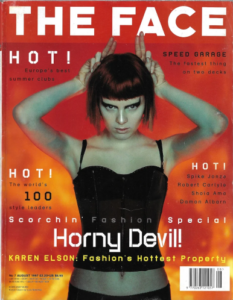
Sheryl Garratt, The Face, August 1997

The summer of love that grew out of the Balearic scene wasn’t as revolutionary as some claim, says Sheryl Garratt

IN THE beginning, there was house. And in the summer of 1988, nightclubbing as we know it was invented. That’s the popular myth, anyway. As with most popular myths there’s an element of truth in it, but it’s hardly the whole story. Revolutions are always far shorter than you think. In England’s Dreaming, the definitive account of British punk, Jon Savage explains how the scene as it first began ended the night the Sex Pistols did their infamous interview with Bill Grundy on December 1, 1976 and the tabloids took over. This was before the Pistols had a record out, before most people knew the music existed. The very moment it went public, the people who created it lost control and it mutated into something else.

The early acid/Balearic scene in London was similar, building via The Project, an after-hours club in a small south London venue in 1987, coalescing at the Shoom parties at the Fitness Centre in the first half of 1988, and finally going overground with the opening of big West End club nights like The Trip at the Astoria on June 4. By July the old clubland pouts had been replaced with smiles, and the temporary suspension of elitist door policies meant that clubs were packed with people from the suburbs who wouldn’t have been allowed in the queue before. The summer of ’88 was an extraordinary time, but it was over almost as soon as it began. When The Trip ended just ten weeks later, people were already talking disparagingly about “acid teds”, flyers and banners proclaimed clubs “an acid-free zone”, and door staff were operating bans on smiley T-shirts and badges

But like punk, the music wasn’t willing to fade that easily. Too many new people had got a taste of dancefloor ecstasy, and scandalised stories in the tabloids only served to create even more converts to the cause. New promoters began to cater to this crowd, holding huge events in the suburbs and countryside. Taking over strange venues, adding funfairs and spectacular decor, breaking the law to dance all night — none of this was new to anyone who had been involved in the Eighties warehouse scene, but suddenly such events were catering not to the few but the many.

It’s easy to forget that house music had been played, even in London clubs, since 1986 when the first tracks started arriving from Chicago on import and Pete Tong released a compilation of house tracks on London Records. Farley “Jackmaster” Funk’s ‘Love Can’t Turn Around’ went top ten in the singles chart in August ’86, while Steve “Silk” Hurley went to number one with ‘Jack Your Body’ in January ’87. By then there was a clear BPM divide in Britain: Scotland liked the faster beats of hi-NRG, DJs like Graeme Park and Mike Pickering were playing house in the North-west and the Midlands, while the South was still fixated on hip hop and rare groove.

But house clubs in Manchester and Nottingham then had none of the frenzy that was to follow, and there were also clubs like Delirium in London, where Noel and Maurice Watson were playing garage and house tracks alongside hip hop, pop and funk, and where Frankie Knuckles came from Chicago for his UK debut (admittedly to a less than ecstatic reception) in 1987. The KLF and Coldcut were already making records, both experimenting with the cut-and-run ethos of hip hop and the possibilities opened up by new sampling technology. Even Norman Jay, one of the London DJs most associated with the retro-funk of rare groove, also played more gospel-influenced garage tunes in his set.

The same is true of party organisers. Danny and Jenni Rampling were new to the game and so brought a refreshing attitude to their Shoom nights, but many other early house promoters were old hands from the Eighties warehouse scene or the suburban soul mafia. The Trip’s Nicky Holloway had already gained a reputation for one-off parties in unusual venues: the dinosaur room at the Natural History Museum, London Zoo, Chislehurst Caves. Graham Ball of Westworld — the team who had brought the idea of funfairs to clubland long before the big outdoor raves — promoted the first “orbital” party off the M25 and helped Jeremy Healy put his brief spell as an Eighties pop star in Haysi Fantayzee behind him and kick-start his career as a house DJ, inviting him to play alongside Norman Jay at Choice.

So clubbing wasn’t invented in 1988. The DJs, promoters, the flyers, the banners, the funfairs, the decor, the battles with the authorities — all that existed before. Promoted by word-of-mouth and with cheap, often badly-designed flyers handed out in West End pubs on the night of the party, there were illegal, all-night events throughout the Eighties in empty office blocks, crumbling warehouses, shop basements and all kinds of other illicit venues. It’s just that some time between the autumn of ’87 and the summer of ’88, they took an E and got faster, brighter, smilier — and this time, far more people knew about it.

House created a church broad enough to allow everyone in; once clubs had been places for people who didn’t fit in anywhere else, who dressed up and celebrated their difference. Now clubs are for everyone, and it’s the people who don’t go dancing at the weekend who can seem like misfits. How that will change when the next short, intense revolution comes around remains to be seen…

© Sheryl Garratt, 1997

Phil Collins: I Don’t Look Like a Sex God

Steve Turner, Radio Times, 31 March 1990

By his own admission Phil Collins is an unlikely superstar. He’s the drummer turned singer, the background boy become celebrity, the chap next door gone to Hollywood.

“I don’t look like most sex gods,” he cheerfully admits. “On my last tour I accumulated some amazing descriptions in reviews: stocky, balding, chubby, stout, urchin, elf, gnome! But I would never feel comfortable wiggling my bottom and dressing up in poncy clothes.”

None of it was planned. He started singing on his wife’s suggestion and only reluctantly fronted Genesis when Peter Gabriel suddenly quit. The songwriting, first displayed on Face Value (1981), was his response to a painful divorce and at the time Collins never intended it for public consumption.

“That event pushed me into writing,” he says. “Then someone suggested I put my home-studio recording out as an album. That’s when it all started happening, but it wasn’t as though I had decided it was time to do a solo album.

“If my missus hadn’t left me I suppose I would have done a jazz album instead,” muses Collins. “And that would probably have been the last you would have heard of me!”

In Radio 1’s new series beginning this Saturday, The Compleat Collins, Mike Read prompts him to talk his way through his career from the days as a drummer in a grammar-school band through Genesis, his solo recordings, his production work and his recent success as a film actor in Buster.

For the five-part series Collins has provided, his own, previously unheard, demos of his hit songs, as well as a private tape of Genesis. As the series shows, Collins is something of a workaholic – a member of Genesis since 1970, an active worker for the Prince’s Trust, as well as producer and actor.

To those who believe that rock’n’roll should be eternally youthful, angry and unintelligible to adults, Phil Collins represents all that has gone wrong. He’s Surrey-dwelling 39-year-old husband and father with an unthreatening demeanour, performing music that executives can pop into their CD players with no risk to their blood pressure. Mums and dads love him and he’s a favourite at Kensington Palace.

“I went through a period where I apologised for being nice,” he says. “But now I say what’s wrong with being a decent human being? I don’t particularly want to go around hitting people just to make me appear like everyone else.”

His most recent songs, released on the album …But Seriously, show him in a pensive mood, concerned about social issues and the responsibilities of parenthood as well as mulling over regrets about his own past insensitivity.

“My dad died eighteen years ago and I regret that I don’t have as many memories of him as I would like to have,” he says of the song ‘All Of My Life’.

“Sometimes I write because things like this are bothering me, but at other times the songs just creep up behind me and write themselves. ‘Another Day In Paradise’wrote itself. I didn’t have to sit down and say, ‘Let’s write a song about the homeless.’ I sat down at the piano, started singing and those words came out.”

Collins doesn’t analyse the market conditions that have facilitated his success. But, as he’s asked the question so often, he has thought about why the songs of an ordinary man from Surrey should have captured the imagination of so many …But Seriously is the fastest-selling album ever in Britain, where it has sold 1.7 million copies. But he’s not just a hit at home. He has reached number one in 22 countries.

“The only thing I can come up with,” he says, “is that I am a straight-ahead bloke. Very simple if you like. I think people relate to that. Judging by the letters I get it’s the lyrics that reach them.

“I write about people, not just relationships. I write about the way we treat each other whether it be in Northern Ireland or in South Africa. I write as a man in the street. Not as the man in the street, but as the normal person I am. I think that touches a nerve.”

[AWH – pop for the rest of us]

If a survey was considered into favourite in-car listening, Phil Collins would be sure to rank high. But who does the man himself listen to when he’s driving?

“At the moment it’s Phil Collins,” he laughs. “It’s my only chance to listen to rehearsal tapes, because when I get home to the baby and ‘real life’ there’s no time.”

He does find time, however, for cult Scottish band the Blue Nile: “I listen to both their albums. A Walk Across The Rooftops [1983]and Hats [1989], both of which I love – particularly Hats,” he says.

“I still listen to 60s records like With The Beatles, a lot of soul music and Tamla Motown. I don’t live in the past but I don’t get much chance to keep up with the latest stuff. I think Lisa Stansfield has a great voice. But mainly I’m listening to my music – because I have to!”

Phil Collins: Genesis Of A Solo Career

Chris Salewicz, Creem, January 1982

SET IN THE STOCKBROKER belt 30 miles to the southwest of London, the Genesis studio complex is exactly what you might expect: several thatched, suitably idyllic, wood-beamed 17th century buildings that until recently comprised a farm, with the studio itself housed in a modern, factory-assembled former cow-shed hidden by the high barn.

At the end of a sunny, late summer day I sit in the garden by a Shakespearian-like leafy cloister on a set of elegantly worn stone steps with Phil Collins, the Genesis drumming and singing workaholic who this year has enjoyed a large worldwide success with his first solo album, Face Value.

Phil’s slight physique and the cut of his thinning hair provide him with a profile at times disconcertingly similar to that of Brian Eno.

In fact, he says, it was working with Eno on his Another Green World album that considerably loosened him up as a musician, altering his attitude towards Genesis: “It showed me that anything could work. We did three days of just blowing. I learnt that you could do something at home, and it didn’t have to sound good – that it was the idea that counted. The logical extension of that was for me to do something at home that did sound good and feel good.”

Ostensibly we are here to consider Abacab, the latest LP by Genesis, a group that I cannot claim to considerably love, largely because the pleasant pop structures that lie at the heart of much of its material have for most of its career been buried in a pretentious, tumescent, musical overkill.

By contrast, Face Value is a loose, open work, strongly influenced by the drummer’s love of black music. Obviously it is significant that Abacab appears more closely related to the Collins solo record than to previous Genesis work.

In answer to the obvious question as to whether he would consider quitting the group, Phil is adamant in his denial.

“As far as I’m concerned,” he insists, “what I do on my own is not a solo career – it’s just one part of me. I’m my own man, and I chose to do a lot of different things. One of those things that I chose to do is still be in a group – Genesis.

“Also, I chose to do lots of different things with other musicians, because that keeps me fresh.

“So I would never leave the band. I see it as such a small part of what I do, anyway. It’s not as though I’m suddenly getting a chance to jack off on my own. I’m on my own already, and I put my energies to Genesis when the time comes round.

“However, I do think that Abacab is a definite step forward in terms of Genesis. By saying that I guess I’m denouncing what we’ve done already, though without meaning to sound as though I’m saying that.

“I’m just proud, though, that we’re thinking more…modern.” Phil admits that keyboardsman Tony Banks and bassist/ guitarist Mike Rutherford are far more willing to accept his idea since the success of Face Value.

However, he claims, the reason the Genesis sound significantly has shifted on this new record is down to their having produced it entirely themselves, in their own new studio – the first music they’ve so made. When he made his own album, which seems as much the cause for the shift in the Genesis sound, he rebelled very much against what he’d been taught was the grammar of studio recording, he explains. And such an attitude was sustained into the work on Abacab.

“We did things like use limiting to excess so that it would really be noticed. We really exaggerated a lot of things.

“I urge people,” he insists, “to forget what they think of as Genesis. There is definitely much more immediacy on this record, which I think is us getting better at writing and not clouding it up with shit. We shied away from stock Genesis devices such as sustained keyboards, and just honed everything down to its barest essentials. A lot of the songs are very, very unlike Genesis.

“We had one track which had the working title, ‘Fast Bass’, which we went ahead and recorded. And on tracks we’d already done like ‘Abacab’, and also for my own record, nothing flash and fast had been done, but just the right thing for the right song:

“But we started thundering along on this ‘Fast Bass’ tune, and suddenly we all stopped. We said, ‘This is what people expect to hear from Genesis.’ So therefore none of us felt frustrated that no matter how hard you tried it always ended up approximately par for the course. But my reason for staying in the group was that I always believed that eventually we would get there. And as far as I’m concerned I want to keep the group going until we get it right. And we never have really done it right.

“But Abacab is the rightest we’ve ever been.

“In fact,” he adds, “we’re totally unlike all those bands that have synthesizers and lights. Recently I did a Radio One Pop Quiz with Dave Gilmour, and he was exactly what I hoped he wouldn’t be. Also, though I really like Jon Anderson as a person, I completely hate that Yes kind of music.

“So it’s a double insult to be compared with stuff that I really can’t stand.”

[AWH- He’s bitchy himself.]

For long in England, much of the criticism of Genesis has been that the group is the perfect embodiment of “Public School Rock”: the English public school system so-called because it is open to anyone – anyone whose parents have the means to pay for it, that is. The smug side of Genesis’s music often has seemed derived on a direct conduit from the self-cherishing, uptight, elitism of that educational set-up.

Both Banks and Rutherford, as well as former members Peter Gabriel and Steve Hackett, all attended the relatively exclusive Charterhouse School.

Surprisingly, Phil Collins goes all the way in endorsing these criticisms of the group’s educational past at which at one time I recall Peter Gabriel bridling irritably.

“For a long time within the group,” he says, “the main problem has been that public school thing. I think it creates an odd feeling within you where you daren’t let go: You daren’t take off your clothes and live.”

Though both the other two Genesis members recently have put out solo records, they met far less success than Face Value. Phil says he received no resentment from them, though.

“There was nothing like that at all. Though Mike said,” he laughs, “‘I’m jealous.’…They view it, I guess, from the point of view that people who liked my album but didn’t like Genesis might give a Genesis album another listen now.

“Mind you,” he continues, “though Tony and Mike might have written more of the material, onstage it was me who linked that material to the audience. They had no personality onstage, and I had. So therefore who’s to say what it is that makes it a success.

“But we’ve always been very equal in the band. Cliched and unfashionable as it may be, we are a democracy. We work very well as a three-piece band because we all know each other’s strengths and weaknesses.

“Since the success of my thing, though, I know when I’m right and when I’m wrong. So I think it’s happening at the right time.”

Another landmark in Phil Collins’ career has just occurred with the release of John Martyn’s new album, Glorious Fool. The record, on which Phil also plays drums, is the first he ever has produced for another artist.

He became good friends with this exceptional Scotsman, says Phil, some three years back when both their marriages suddenly disintegrated.

Indeed, it was Phil’s split with his wife that inspired many of the Face Value songs.

“I came back from tour in 1978 to find my marriage gone,” he shrugs his shoulders in an attempt at being philosophical “We can talk to each other nowadays, which we never really did while we were married. Which was probably why we had to get divorced.

“That was a reason why Peter left the group, in fact: his marriage was in bad shape.

“You can’t really expect someone to understand why you have to be responsible to three other people. You can’t say to them, ‘Oh, I don’t want to go on this tour because I’ve got to do this instead,’ when they’re going to have to do the same thing next year. And it depends on the lady you’re mated with whether she can adjust to that. And my wife couldn’t.

“Now I’m with a lady who gives me much space as I need.

“But it’s an odd situation to get into. We were too much alike, I guess, and we’d end up at each other’s throats. Which was bad for our two kids, of course.

“But now we can always hang up on each other,” he laughs sadly, “whereas before it was never like that.”

© Chris Salewicz, 1982

Siouxsie Sioux who R U?: Siouxsie & the Banshees

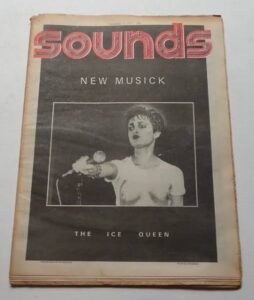
Vivien Goldman, Sounds, 3 December 1977

PREMISE: Record company executives have been skipping the brandy on their expense account lunches in their eagerness to sign up any band that can loosely be defined as “punk”.

FACT: Siouxsie & the Banshees are certified members of the advance guard of the New Wave – their first gig was at the 100 Club’s legendary Punk Fest a year ago.

FACT: Siouxsie & the Banshees hold the house attendance record at the Vortex on the club’s second night.

FACT: Siouxsie & the Banshees have not been offered any record deals.

POSTULATE: Who are these people? Stepping razors or what? They must be dangerous…(“EMI said they’d take us on if they could control our lyrics.” – Steve Banshee)

“They’re so ignorant. Look at all these arseholes that are signed up, that’s proof. I consider it a compliment in a way, but – I just don’t know why…” – Siouxsie Sioux*

ANYONE WHO READS the rock press – and that means you, fellow fan – can come up with a couple of reasons why Siouxsie & the Banshees are the last interesting unsigned band. When it comes to Bad Press, this outfit get the Duke of Edinburgh Award. Just too many quotable quotes for your own good, eh, Banshees?

“I thought of the name Siouxsie & the Banshees when I knew we were going to play the 100 Club. I just wanted a name that sounded inoffensive but would get people confused.” – Siouxsie

BANSHEES EQUIPMENT:

1 bass guitar, non-functioning

1 guitar

1 practice amp

2 drumsticks

“We’ll do it on our own terms. We’re not gonna water down things to make it acceptable to the people who sit behind desks. It does matter because we want to get across to a lot of people. But we’ll continue to such a degree that no-one can ignore us. For a band that hasn’t been signed, we’ve had an incredible amount of publicity. That’s why we’re doing this interview, to get across…”

“This band must not be encouraged” – The man from the Melody Maker

I didn’t approve of Siouxsie Sioux. Like a showroom dummy, I believed what I read in the papers – yes, that means Sounds. Flash back to the montage of headlines my subconscious had filed under Siouxsie & the Banshees: Belsen is a gas, laughing at cripples.

Two things converted me:

1) Seeing Siouxsie + Banshees at the Music Machine supporting Richard Hell. Teenage Rampage circa 1980. Heavy Metal circa 1984. Music for those quiet evenings at home, getting it on with the House Android. The cold, cold wave breaking over your head, and for one second you don’t know whether you’re going to see daylight again. Or play the violin (the old jokes are the cold jokes.)

2) Talking to Siouxsie.

The taxi drive to Chislehurst, chez Sioux, was uneventful. I was eager to see the home of the suburban saboteur – would I be occupying the seat of the cab back as a lampshade? With a name like Goldman, you can’t be too careful.

Pond, complete with ducks, deep in the heart of little box land. Siouxsie’s street, I discover, is a step up – the semi’s are built in different styles. Siouxsie’s berthed in a desirable facsimile of a 30’s oceanliner, curved so you can almost see the chrome-from-chrome.

The interior’s funeral-parlour mauve, claustrophobic prints pull the walls in and over your head. But there’s a fire next to the colour telly, and Steve and Siouxsie watching the soaps, in a perverse echo of Happy Families.

Siouxsie is very obviously intelligent. Too intelligent and articulate for a girly-girly-girl. At 20, she’s got the assertiveness I still grasp for at 25. One look into her level, inquiring brown eyes is all it takes to know she’s as likely to take shit as I am to flog my typewriter for a new frock. Maybe that’s why she hasn’t got a record deal.

On the sideboard, there’s an illuminated scroll in a frame. Some guff copied from a New England tomb or suchlike – it kicks off with “Go quietly into this place,” and continues to preach the virtues of modesty, tolerance, passivity.

“My aunt gave me that,” Siouxsie comments cheerily. “It hasn’t worked.”

Siouxsie says she hates labels. She nevertheless liked being called the leading woman of the cold wave in last week’s Sounds. She felt it fits. When Siouxsie was a little girl, she wanted to be a surgeon. Or a barmaid.

“I could never be a doctor in the sense of helping people. I could never be a nurse, helping old people with bedpans and all that shit. I just don’t want to help people.”

Cold? Icebox.

Why?

“I don’t like a lot of people. I think everyone should help themselves.”

Self-sufficiency. Is that what they teach Girl Guides? I never made it into the Brownies, so I wouldn’t know. If Siouxsie had her way, there’d be no Welfare State. What would happen to dole-queue rock with no dole?

“I’ve just got a low tolerance of people who can’t help themselves.” Siouxsie looks as if she feels mistress of her own destiny. The tartan lumberjack shirt, the man’s tapered slacks, are geared to functional efficiency, they’re workers clothes. Even the fluffy red Marks & Sparks mules fit the image – it feels like the Ice Age has landed this afternoon. Bondage trousers and gold stilettos would indicate a lunkhead punk head.

“I would wear shorts on stage quite a lot, mainly to be able to move around. I move to the music, the music is the most important thing. That’s what makes me look that way, it’s very cold and blue.”

That way, Siouxsie onstage, stripped for ease of movement, plus elemental eroticism, is half-gymnast, half-warrior, I’d always assumed she’d adopted the name Siouxsie Sioux for the Red Indian fighter resonances. She says she wishes she’d thought of that. I say that’s irrelevant – even if she didn’t consciously ally herself to that association, she was drawn to the name because on some level, she knows what it means to be a Sioux warrior.

And that’s worrying. Not to Siouxsie, but to the media, and the execs.

“The way we started off, we really didn’t want to explain anything. We repeat ourselves so much in interviews, but you’ve got to do that. Really, I don’t give a damn, but I want the band to last.”

Siouxsie and Steve Banshee are in perfect accord when it comes to describing their music. Cold, machine-like, and passionate at the same time.

Siouxsie: “I like to think the vocals rely a lot on sound rather than tune. Nobody in the band’s into melody, thank God…” Watching Siouxsie + Banshees perform is chilling and intense/off-putting, depending. Siouxsie strutting round the stage, confronting/compelling the audience, belting out the lyrics like machine-guns rattling through strips of bullets.

Have you heard the one about the unloved butcher’s assistant who fell in love with the carcasses he handled every day? He wound up chopping off his arms and legs and skewerin himself on a meat hook beside his loved ones – “limblessly in love”, the chorus cracks out in a relentless screaming monotone. An alluring line, even if you can’t hear the rest of the words.

My favourite’s ‘Suburban Relapse’: “I’m sorry that I hit you but my string snapped/I’m sorry I disturbed you while you cat-napped/but while finishing a chore/I asked myself what for?/I had a relapse, a suburban relapse, while washing up the dishes…my memory gets hazy, I think I must be crazy…”

All Siouxsie’s songs are drawn from life. She collects clippings from The Sun for inspiration: “You always find people doing the weirdest things, like this bloke who put his leg on the railway line because he wanted to claim more money as a war hero. And the woman who wheeled a chopped-up body around in a pram. It’s all there, in The Sun every day.”

Siouxsie & the Banshees’ sound like a 21st century industrial plant; people that find it dreary or oppressive are romantics reacting against the machine age. Listen to the cold wave roar from the ’70s into the ’80s. “Maybe it’s because there’s a new Ice Age coming on,” says Siouxsie.

Yes, Siouxsie did say all those things. And she doesn’t say anything she doesn’t mean. But speaking as the offspring of German Jewish refugees from the Nazis, with a paranoia quotient in the 80s and likely to flare up at any moment, I still think they’re on my side of the fence. (I think.) Here’s the scam. I’m sitting in an armchair flicking though the excercise book with Steve’s lyrics handwritten inside. I’m reading ‘Love in A Void’. I read the line “Too many jews for my liking,” followed by a string of similarily derogatory remarks aimed at various sectors of the community (journalists came next, actually.).

So Su? One minute you’re telling me that you’re not Nazis (they dropped the one-arm salute when people told ’em it smacked of that Wehrmacht vibe, and they dropped the swastikas because people weren’t latching on to it the way they’d intended – swastikas as ancient druid symbol, Lenny Bruce-style removal of taboo by exposing rotting myth to the sunlight, et cetera) and the next minute I’m reading this?

Steve: “That’s gonna be changed when we think of something to put it, but it was never meant to be anti-Semitic.”

Siouxsie: “‘Too many jews’ means, like, too many businessmen. That line was stupid anyway. We knew what we meant, but…” In Steve’s explanatory notes to ‘Mirage’ he comments that he’s confused about the full meaning of the song, and the song expresses that confusion.

Siouxsie: “‘Mirage’ is about ‘the image is no images/ it’s not what it seems.’ It’s about people seeing us and taking what we do superficially.”

But what else can you expect when you’ve only examined your work superficially?

“I’m learning to be precise when it comes down to politics, race, religion. I realise all that now. I’ve been reading books, researching my facts, and there’s more I should read. I’ve never been one to mince words, and it’s always got me into trouble.

“Also I’ve got a warped sense of humour. I suppose it’s bad, but it’s not meant to offend. It’s like laughing when someone falls over in the street, or in the early bit of a disaster movie. Most people stop at a certain point, when it’s not funny. I’m sure they’d all like to laugh, but they don’t think it’s proper.” I don’t agree with you there. I reckon people stop laughing when it’s not funny because it’s painfully close to home, in a there-but-for-the-grace-of-god way.

“I just do. Even when my dad died, I just laughed. That was my reaction. I felt completely unmoved.”

Presumably you never felt very close to him.

“I suppose I’m a very cold person as well. The fact that I reject anything communal… I’ve been in people’s families where their mum says, ‘What do you want for tea, what do you want for dinner?’ I’ve always got my own food in this house. I’ve had my own door key since I was about seven, just let myself in from day nursery or school or whatever. It may seem like a cosy atmosphere, but we’re all separate people with quite separate lives, not like a family at all. My mum’s acutely schizophrenic, paranoid. She gets so angry about trivial things, thinks they’re directed against her. I don’t want this put in if it’s gonna be like – poor old Siouxsie. I hate all this business about the Clash living in slums, I know they’re trying to win pity, and it goes against them.”

Whether Siouxsie’s interpretation is correct or not, she seeks no pity as she describes her recent calamities. Starting off with the brush with the law reported in recent issues of Sounds, which turns out to be a bona fide horrorshow/miscarriage of justice. The precise details of how Siouxsie was hauled off to the cop shop while waiting for a cab outside the Rainbow after a Heartbreakers gig are disturbing to say the least.

She wasn’t allowed her statutory phone call at the police station, she was hauled out in the rain at 4:00 a.m. with no shoes on – they’d been seized as lethal weapons – she had to endure threats, dirty jokes, and policemen sitting on her head (“They’re really fat, these policemen,”) Her case was put forward when her manager Nils had been told that it would actually be delayed to allow time for her solicitor to get to the court. The ?.00 fine was the least of it.

She appears to take all abuse in her stride. Except, “I was really insulted when the NME said I moved like a corroded Blondie. Just because I’m a girl they have to compare me with another girl who’s doing something now. I can’t have any respect for criticisms like that.”

Understandable. The only conceivable point of comparison between Siouxsie and Blondie is that they’re two penis-less creatures making music on the same planet at the same time. Blondie deserves her own place in contempoary music – lively pop has to be there for threatening, dangerous , music to exist as threatening, dangerous music. If Debbie and Siouxsie were to perform side by side on the same stage, Blondie’s pocket-Venus charm and kittenish karate kicks would be a sweet, milky foil for Siouxsie’s power-driven mobility. Siouxsie, crouched on her haunches at the edge of the stage, taunts the audience; Blondie woos them. I know I find Siouxsie more exciting.

And the only reason for extending the spectacularly dumb comparison is the fact that “serious” rock writers can still compare two musicians because they’re the same sex (would you compare Perry Como to Joe Strummer? Why not – they’re both men aren’t they?) underlines the fact that this country has a long way to go before woman musicians will be regarded as musicians.

“I know that people still come to see us because there’s a woman fronting the band. But I think I put them off with the way I behave.”

The Banshees don’t believe in pandering to an audience anyway

“So many bands want to be liked by the audience, they want to be the same as the audience. That’s so false. The first time we went onstage at the 100 Club, the idea was to annoy and bore people so much they’d chuck us off, but we got bored before they did…I really enjoyed it.”

Even before Siouxsie’s life was changed by seeing the Pistols at an Art College, before she became a member of the Bromley Contingent (the original clan of Pistols fans) trekking about the country. Even to Paris, for a shot of punk energy, she wanted to perform.

“I was holding back because I was put off by every other girl that was trying to get into the music business. They were all manipulated by men, singing pretty songs. So I just waited for something to happen. And it did. Just at the right time.”

The Pistols impact, came after Siouxsie (age 16) had attended a series of grisly auditions picked out of small ads, Siouxsie would be told to sing ‘Walk On the Water’ for a bunch of geeks who saw a woman singer as a novelty item (“that was off-putting”), must have been like the first breath of air when you’re let out of prison.

“It’ll be great when people realise that a woman musician isn’t a miracle, isn’t anything to laugh at either. Still, a lot of women being put down has to do with woman being stupid themselves, believing everything they’re told. But rebellion’s starting to grow.”

Do you see yourself as a leader of the rebellion?

“I don’t see myself as any Joan of Arc or anything, but it would be great if other women would follow in my footsteps. I think what the Slits are doing is just great.”

It can be lonely being in the vanguard of a movement. But Siouxsie’s temperamentally suited – she enjoys being on her own, and as far as I can make out, she relates more closely to her cats Cookie and Crystal than to almost anything on two legs.

“They’re soppy names, I know, but I called them that years ago. I’m more affectionate with them than I am with people. They’re so useful for talking to. I’m in love with cats’ faces, their noses, I like their temperament, because they don’t give a shit about anyone. It sounds soppy, but we really communicate.”

© Vivien Goldman, 1977

Abba: Oompah?

Mick Farren, New Musical Express, 24 April 1976

What’s squeaky-clean, exquisitely produced, Scandinavian and goes OOMPAH? The answer to the riddle is ABBA …and here’s MICK FARREN to ask it.

THEY’D TOLD us that Stockholm’s numero uno disco nightclub was a place called Alexandra’s. From the way the muscle on the door looked at you when you told them you had a table booked, you could almost believe it was the city’s most exclusive niterie.

Inside, it’s black glass, mirrors and the kind of Edwardian whorehouse lampshades that they were selling in Biba’s five years ago.

On the miniscule dance floor a young woman who looks like a kind of lumpy, muscular Bibi Anderson is performing something that resembles a cross between the frug and Canadian Air Force Advanced Physical Training Routine. Another equally strapping couple join her on the floor. They start into a soft core porn-by-numbers version of The Bump.

An overweight computer salesman leads an equally overweight young woman out to join the other couples. They press against each other. The salesman rubs his hands over her thighs. They sway, roughly in time to the music. Right at that moment it’s Barry White. Later it evolves to the 1966 Spencer Davis Group.

At nearly three pounds for a drink it’s not even possible to get drunk. The whole image of Sweden as wall-to-wall Britt Elkands falls apart at the seams.

And who sent us into Alexandra’s, this feast of Scandinavian delights? None other than Bjorn Ulvaeus, one of the masterminds behind the group called Abba, the first Scandinavian pop ensemble ever to make a dent in the international entertainment industry.

I guess the only way you could have failed to be exposed to Abba’s particular brand of open-face. Ultra-Brite pop is to have spent the last twelve months in a sealed fallout shelter. Only someone totally insulated from radios, televisions and even pub juke-boxes could have missed them. Since their Eurovision Song Contest win in 1974 with a song called ‘Waterloo’, their music has poured forth in an unrelenting stream from just about every kind of electronic medium.

They’ve had hits (not one but virtually sequential hits, one after the other) in Britain, the U.S.A., most of Europe, Hong Kong, the Philippines and Australia. In Australia they beat both Sinatra and Andy Williams in TV ratings with their telly special. About the only market in the world that they haven’t solidly dented is Japan, and that seems only to be a matter of time.

Right about now (unless you’ve already given up and turned the page) you’re probably wondering what in hell am I doing going on about Abba? Has Farren lost his marbles, suffered brain damage, been bribed? (Funny you should mention it-Ed).

No, my friends, it is not what you fear. Just bear with me a while longer and all will be made clear.

Anyone who comes so fast and hard out of left field and sells so many millions of records has to qualify as a PHENOMENON. A squeaky clean phenomenon for sure, nowhere in the same bracket as Lou Reed, but a phenomenon just the same.

“Wait a minute,” you cry, “surely if a big corporation hype is being undertaken it’s no great hardship to use a band that’s a novelty in terms of its country of origin? Isn’t it just the Osmonds in a Bergman location? If they did it in Salt Lake City they can do it in Stockholm.”

That would be quite true, except for one thing, Abba are not the product of some faceless corporation mogul in the Hollywood Hills, with IBM time and lots and lots of money. Sure they’re a manufactured product, but the men behind them are Benny Andersson and Bjorn Ulvaeus, who happen to be in the group, and Stig Anderson, who is the boss of the almost one-man Polar Records label that had previously catered solely for the Scandinavian market.

In form and style, their closest antecedents are the early days of Motown – or maybe Philles.

Once again I hear the cries starting – Abba? Motown? Philles??

Okay, I know Abba don’t sound anything like either Motown or Philles. They aren’t funky, they have no soul and they’re bland to the point of making baby food seem raunchy. It’s the structure that produces the music that I’m talking about – and also the fact that a frightening amount of work goes into each one of their records.

Admittedly, to an ear that’s been weaned on rock and roll it’s hard to detect. I’d dismissed Abba as audio pablum and closed my mind whenever I heard ‘Mamma Mia’ in the pub until a couple of my noble colleagues pointed out just how complex the Abba backing tracks were.

They were right, too. It took quite a while to strip away the eager, healthy vocal sound, the cute-to-the-point-of-moronic lyrics and the continually bouncing Nordic boom-boom hereafter referred to as Eurobeat. Once that’s done, you’re actually left with a pop structure in the grand manner of The Beatles or Spector.

So grand, in fact, that it would be more than likely to go clean over the head of the average Abba punter.

The whole thing was sufficiently intriguing that, when the chance to go to Stockholm and look at Abba in their natural habitat came up, I went to investigate.

THE NATURAL habitat of Abba varies between a large, rather elegant house near the center of Stockholm and an island retreat outside the city. The house is where all Abba’s business is transacted; the country house is where they retire to at regular intervals to write, record and produce more songs.

The first part of the Abba story came from Stig Anderson. Anderson has medium length hair and the craggy features of a Hemingway character. He has been in the music industry since the early ‘60’s.

In 1971 his partner died and it was suggested that he hire Benny Andersson as a producer. Benny brought Bjorn Ulvaeus and as Benny and Bjorn they created a couple of Swedish hits. Then, teaming up with the two girls they made ‘Ring Ring’ which, although it made no mark on the U.K. market, was a major hit in Northern Europe. From there, world domination was in sight.

While Andersson talks, he is constantly interrupted by calls and secretaries. His office is just what you’d expect of a Swedish record company whose main attraction is Abba. It’s all bright, clean, stripped pine efficiency. The only thing in the entire room that doesn’t fit with the squeaky clean image is a big, almost life size painting. It’s of a schoolgirl in gymslip, crisp white blouse is unbuttoned and one breast is exposed. Her discreet and presumably masturbating hand has slipped under her skirt. The style is ultra realism. It’s the only sign of decadence in the whole Abba operation.

Stig Andersson is a very definite part of the team that produces Abba’s records. He writes some of the lyrics and generally lets Benny and Bjorn use him as a kind of sounding board. They try out new songs on him first and depending on his response they decide what’s commercial and what isn’t. Although I can no way go along with his taste there’s no denying that, so far, he has an uncanny feel for public taste, but so, for that matter, has the editor of The Sun.

We move downstairs to a basement office to meet the group themselves. A photo session is winding up. Abba have been decked out in Daily Mirror Pop Club T-shirts. The two girls, Frieda and Anna, drop into instant posed animation for the camera. In between they seem kind of bored.

Benny and Frieda are engaged. Bjorn and Anna are married.

That’s right, folks, it’s a family act.

Bjorn Ulvaeus is thin and intelligent, he tends to do more of the talking. Benny Andersson is bearded and jovial. Anna and Frieda have the aloofness of the professionally decorative. It quickly becomes clear that they do not play any great role in the creative side of the act. Shortly after the interview they leave the room.

There’s a little initial fencing around. The two men are open and friendly. They are neither idiots or cynical pap-pushers who calculatedly feed the public what they think they want. They obviously like the work they’re doing, take great pains with it and are anxious to extend their creativity as far as possible.

They are both products of the somewhat isolated Scandinavian pop scene. Bjorn played with a folk outfit called Hootenanny Singers, while Benny was in a band called the Hep Stars who played “Hermans Hermits songs and that kind of thing.” Just the name conjures up pictures of what these groups must have been like. I have visions of earnest Swedes solemnly intoning M.O.R. babble learned off the records.

“You have to realise that, in Sweden, we don’t have the rock and roll background that there is in Britain or America. We listened to Chuck Berry and The Rolling Stones of course but we didn’t quite grow up with them in the same way that you did.”

I ask them about Eurobeat. Why are they so obsessed by that jolly, obnoxious boom-boom?

Benny volunteers: “That is the popular traditional music of the Northern Europe. Our folk songs sound like that. The first instrument I ever had was an accordion. My parents bought if for me when I was about ten.”

An accordion! It seems to almost symbolise the problem of Abba. It fits, but it’s hard to explain. Outside of maybe Clifton Chenier, as far as I’ve ever been concerned, the only good accordion is a dead accordion. I think we have maybe defined the culture gap, if not bridged it.

Earlier, in Stig Andersson’s office he had played me a cut called ‘Intermezzo’ from the album Abba. It’s obviously the prime example of Benny stretching out beyond the song Song For Europe format. It’s an instrumental from the Wakeman/Emerson/ Moraz bag, except the Eurobeat bounces through it. It is impressively put together. A lot of work and technical skill obviously went into it and it gets right up my nose. It also proves that Eurobeat is so deeply ingrained in the souls of these Swedes that they will probably never lose it.

The time comes when there’s no getting round the central unpleasant question: “How come you take so much trouble with the production of the music on your record and then stick these moronic lyrics over the top?”

I do my best to phrase it more politely, but it still comes out sounding mildly insulating.

To my surprise nobody is actually insulted. Benny shys away slightly. “We don’t want to write political songs. We don’t want to turn our records into speeches.”

I explain I didn’t mean politics, just imagery and content. Love songs can have a hell of a lot more depth than anything Abba have ever attempted. I point at examples like ‘Yesterday’, California Dreamin’ and ‘God Only Knows’. Bjorn looks thoughtful.

“I’m glad you brought this up. It is possible that we’ve been concentrating too much on the music and neglecting the lyrics. You have to realise that it is very hard to create images in a foreign language.”

You always write in English?

“Yes. So few people speak Swedish.”

It wouldn’t be possible to do something part English and part Swedish, the way McCartney used French in Michelle?

“Anything’s possible. I think we are becoming far more fluent in English. Since we’ve been touring we find it much easier to express ideas.”

The interview changes into a discussion of lyrics. Both Benny and Bjorn seem anxious to learn all they can. It could simply be a case of flatter-the-journalist-so-he-writes-nice-things, but I do get the feeling that these guys who have suddenly started producing world-side hits from what must be a musical backwater, want to soak up information like sponges.

The conversation moves on to morality.

Don’t you feel that, with Abba, you could almost be turning out a kind of palliative; jolly songs that create the illusion that things aren’t as bleak as they really are?

“Bleak?”

We are in the middle of a depression.

“We don’t plan in advance what we are going to do. We just go to our island and record whatever’s in our heads.”

Bjorn joins in: “We have not felt the effects of the depression too much in Sweden.”

I think about the people merrily knocking back their £3 drinks. Perhaps he’s right.

There’s one other thing I feel I ought to find out about. Abba are a group who have been promoted to a large extent by the medium of television. What do they do when they play live?

“We don’t play a great many concerts. It’s a problem to reproduce what we do on record live. When we do play we have something like 17 people on the stage.

“We also don’t like to be committed to lengthy tours. It means we can’t go out to our island and record. This is the most important thing.”

Surely when you go to America to play concerts you’re going to be pushed into the Las Vegas circuit?

“We don’t want to become a Vegas act.”

That is very firm. I wonder how these earnest Swedes are going to deal with the big league music Mafia.

You don’t feel the need to play regularly to a live audience?

“Not at the moment, but things are always changing.”

A bottle of Aquavit comes out and the interview winds down. I don’t really feel I’ve got the whole picture. I’m not sure I’d have it if I spent a whole week with Abba. Finally Bjorn drives us back to the hotel. This, in itself, is pretty unusual for a pop star.

I suppose that brings us back to where we came in: The gymnastic frug in the discotheque. Abba (and young Sweden, for that matter) appear serious, hard working, painstaking and eager.

Unfortunately, they don’t have natural rhythm. And that’s why Abba are Abba, and not The Beach Boys.

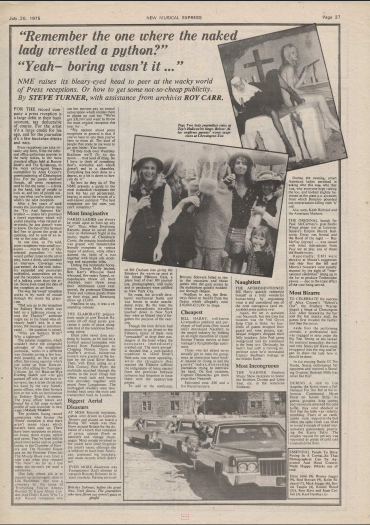
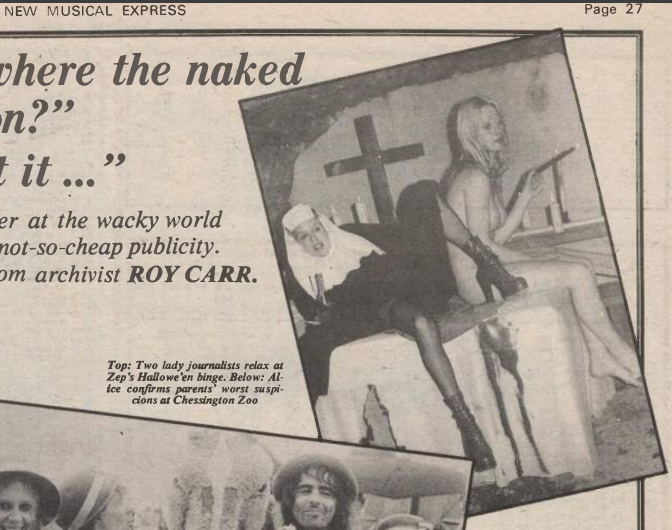
“Remember the one where the naked lady wrestled with a python?” “Yeah – boring wasn’t it…”

Steve Turner, New Musical Express, 26 July 1975

NME raises its bleary-eyed head to peer at the wacky world of Press receptions. Or how to get some not-so-cheap publicity.

FOR THE record company a press reception is a large debit in their bank account, tax deductable of course. For the artist it’s a large credit for his ego, and for the journalist it’s a few buckshee drinks and eats.

Press receptions can take virtually any form, from the informal office gatherings popular in the early sixties, to the more standard affairs held at Ronnie Scott’s and The Speakeasy, to the more extravagant binges exemplified by Alice Cooper’s commandeering of Chessington Zoo. For the guests involved though, all press receptions tend to feel the same – a drink in the hand, lots of people to look at, and lots of people asking you what you’re doing now/when’s the next reception.

After a few years of such events the journalist moves into the ‘Try And Interest Me’ bracket – unless he’s promised a (new) experience which will sound amusing when related afterwards, he just doesn’t want to know. On top of this he must feel free to ignore the artist in question, and be sure of an invite to the next affair.

At one time, so I’m told, press receptions were small occasions – maybe forty of fifty selected journalists – who would gather, listen to the artist play, have a drink, and conduct an interview. Coverage was guaranteed. As the rock industry expanded and journalists multiplied, competition set in, and the reception became more of a talking point than the artist. Some even toted the idea of the reception as art-form.

The way the ‘event’ reception works is by word of mouth through the music biz grapevine.

“Did you go to the reception for Solitary Brick which was held on a tightrope strung across the Thames?” someone might say to his friend who obviously hadn’t and, in a sentence, the message is communicated…the question is raised.

“Who are Solitary Brick? Why a tightrope?”

The smaller reception, which wouldn’t move the congealed adrenalin of the established journalist, works in a different way (besides saving a few hundred pounds). At this type of affair, the young reporter who’s just come up from Ross-on-Wye after editing the Teenagers Column for the Ross-on-Wye Evening Gulch and who gets palmed off with all the bum interviews, has a drink thrust into his hand by the very friendly press officer, who then favours him or her with an introduction to Solitary Brick’s drummer. The press officer leaves and hopes for a full page in-depth profile of said drummer in next week’s Malady Manker.

The problem facing record companies who favour the ‘Event’ reception is that there aren’t many ideas which haven’t been used up. There have been receptions on planes, on boats, down crypts, cellars and caves. They’ve been held in plush hotel suites and on garden lawns, in the Chamber of Horrors and The Haunted House sets on the Hammer Films lot. The Moody Blues even hired a tube train when they released ‘Go Now’. As far as I can make out no-one’s yet used a submarine…

One lady whose job is to conjure up extravagent ideas is Lila Burkeman, who runs a company by the name of ‘Everything You’ve Always Wanted To Know About London And Didn’t Know Who To Ask’. Record companies who use her services pay an annual subscription which entitles them to phone up and say “We’ve got £X,000 and want to throw the most original reception this year for…”

“My opinion about press receptions in general is that if you’ve been to one then you’ve been to them all. The kind of people that come to me want to go one better. You know.

“If they took over Wembley Stadium we’ll fly to the moon…that kind of thing. So I have to think of something that’s workable and which doesn’t end in a shambles. Everything has been done to a degree, so a lot is down to how you do it.”

So how do they do it? The NME presents a guide to the most outlandish receptions the rock biz has yet perpetrated, bearing in mind the remark of a well-known publicist: “The best receptions are the ones you can’t remember.”

Most Imaginative

NAKED LADIES can always be relied upon to liven up any “do”. Thus, when Swansong Records chose to unveil their label on Halloween Night in the murky depths of Chislehurst Caves, the ensuing bacchanalia was graced with innumerable friendly nymphets in various stages of undress, while others donned the habit of a nun together with black silk stockings and suspender belts.

During this hedonistic hootenanny, George Melly letched, Bob Kerr’s Whoopee Band whooped, fire-eaters fumed, escapologists threw off their shackles, nuns threw away their inhibitions (and vestments), the grotesque Glimmer Twins and various guests threw up their rings, and Swansong threw up £5,000.

Needless to say, it was a resounding success.

THE ELABORATE preparations made to give Rocket Records lift-off must surely guarantee it pride of place alongside that of the notorious Swansong soiree.

Elton John never does anything by halves, so he laid on a football special (complete with disco) from Paddington to Chipping Norton. Upon the chuffer’s arrival, boisterous looners were greeted at the station by the local Silver Band. Then, with Elton acting as a 20th Century Pled Piper, the multitude marched through the streets to the local village hall where much tuck and booze was provided, together with music from Longdancer. The bedraggled revellers were later herded back onto the train and transported back to London.

Biggest Aerial Disasters

AT MGM Records invitation, guests were driven to Gatwick Airport and placed on board a Boeing 707 which was then flown around Britain for the duration of a lunch that consisted of caviar, salmon (fresh or smoked) and vintage champagne. Most people involved in the junket have since forgotten the artist’s name, although she is believed to have been American, possessed big knockers, and made records which didn’t sell.

EVEN MORE disastrous was Famepushers (Ltd) attempt to catapult Brinsley Schwarz to instant stardom. Having persuaded Bill Graham into giving the Brinsleys the warm-up spot at the famed Fillmore East, a plane load of over 100 journalists, photographers, and radio and tv producers were airlifted to New York City.

En route, the aircraft developed mechanical faults and was forced to make unscheduled stops. By the time the tired transatlantic travellers touched down in New York they were so blitzed they’d forgotten the purpose of the exercise.

Though the limo drivers had instructions to go direct to the Fillmore, many of them were “persuaded” to drop their passengers at the hotel where the occupants immediately crashed-out. The more energetic decided that a mob-handed expedition to 42nd Street’s flesh-pots was more appealing, while the stragglers that reached the Fiilmore suffered the indignation of being ejected from the premises because someone had forgotten to issue them with the appropriate passes.

To add to the confusion, Brinsley Schwarz failed to rise to the occasion and those guests who did gain access to the auditorium quickly nodded-out through fatigue.

Needless to say, the Brinsleys failed to benefit from the fiasco which allegedly cost £10,000-£15,000 to stage.

Cheapest

BILL HARRY, well-known Liverpudlian publicist and purchaser of half-pints (first round only) introduced Nazareth to the record industry by holding an all-night marathon of classic Science Fiction movies at their manager’s Knightsbridge apartment.

Those who did attend never actually got to meet the group, since an obnoxious band booker insisted on trying to pull the guests’ ladies, distracting journalists trying to interview the band. On that occasion, Captain Obnoxious got more press than Nazareth.

Estimated cost: £60 and a few frayed tempers.

Naughtiest.

THE AFOREMENTIONED Bill Harry quickly redeemed himself as a truly wonderful human-being by organising what is still considered one of the most outrageous (and enjoyable) press parties ever.

Again, the act in question was Nazareth, but this time the location was the Nell Gywn Strip Club in Soho. As hundreds of guests dropped their guard and wine glasses, statuesque strippers dropped their frilly knickers. John Peel came overground and sat transfixed in the front row. Obviously, he hadn’t had such a moving experience since he’d introduced Captain Beefheart onstage at the Middle Earth.

Most Incongruous

THE WARNER. Brothers Music Show reception to honor the Brothers Doobie and Little Feat, etc. in the American Embassy.

During, the evening, smart American ladies persisted in asking who this was, who that was, why everyone kept visiting the loo, and looked slightly bemused at the giant p.a. speakers from which Bonaroo pounded out conversation-killing rock ‘n’ roll.

Also seen, Keith Richard and the American Marines.

THE ORIGINAL launch for Paul McCartney’s post-Beatle Whigs phase was at Leicester Square’s Empire Mecca Ballroom. Dress was formal and the Band of the night – Ray McVay (oyvay) – was issued with strict instructions from Paul not to play any of those old Beatle toons.

Reportedly, EMI were shocked at Mecca’s suggestion that they foot the bill and Mecca’s bouncers were equally stunned by the sight of “international celebrities” lining up in the loo to produce Technicolor yawns – due to the toxic effect of the vino being served.

Most Bizarre

TO CELEBRATE the success of Alice Cooper’s School’s Out, the Brothers Warner staged a binge at Chessington Zoo. After ransacking the bar and the hot snacks stall, the guests first invaded the funfair and then the circus.

Aside from the performing animals, a professional lady was engaged to strip under the Big Top. Seeing as she lacked the essential sensuality, the two and only Stacia (of Hawkwind) swaggered into the ring and began to show the lady how it should be done.

In the ensuing Battle Of The Boobs, Stacia outbreasted her opponent and received a Standing Ovation. Bertram Mills was never like this!

DURING A visit to Los Angeles, the Kinks threw a Felliniesque Fol Der Rol at the infamous Continental Hyatt Hotel on Sunset Strip. As guests, groupies, drag queens and musicians attacked the cold buffet, they were shocked to find that the table was violently trembling. Fears of an earthquake were nipped-in-the-bud when the table cloth was lifted to reveal a couple of naked merrymakers passionately practising the Kama Sutra. The couples request for privacy was respected as plates of cold cuts crashed to the floor.

© Steve Turner, 1975

ABBA: Waterloo

Gene Sculatti, Zoo World, 12 September 1974

MOST EUROPEANS would, quite rightly, give their balls to suck Slurpees at a 7-11 or grow up absurd on Yankee turf, but they don’t get the chance. So lots of them do it by proxy, synthesizing what they hear (and what they think they hear) by way of records and radio.

ABBA’s Waterloo is a brilliant program, a compliment to Continental brainpower, synthesizing a dozen styles, robbing the graves of long-dormant Past Masters like Brian Wilson, Neil Sedaka, even Phil Spector. Some of it sounds like Lobo, some like the Hollies, some like reggae, some like the Monkees – but the blend is compelling not for this attentive detail-copying, but more for its timing. ABBA music is ultimately a skillful adaptation/appropriation of previously available elements – it’s just that nobody thought to combine them in this manner before.

You know the title track: high-profile piano pop coasting off Napoleon B’s isolations and the first real girly group-singing since maybe Martha’s ‘Jimmy Mack’ or some late Supremes stuff. ‘Suzy Hang Around’ unwinds as folk-rock (torn intact from the Byrds’ ‘Chimes of Freedom’) and skips to a lyrical rope strung tight between the Archies and Edison Lighthouse. Love it, especially the 12-string and cello saw.

‘Ring Ring’ is perky girl group fluff, Anna and Frida doing it all with their noses, a la Neil Sedaka himself (who co-furnished the lyrics). ‘What About Livingstone’, built on another Bonaparte-type myth, at 2:54 sounds set to follow ‘Waterloo’ with baby-lovin’ success into one or another winners’ circle.

‘Watch Out’ couples a Monkees-type melody/arrangement to a Reg Presley punk-sneer lead vocal, either from Bjorn or Benny. ‘Honey Honey’ picks up where the Archies left off, right around the second verse of ‘Sugar, Sugar’, with 1960’s gal group style and Buddah bubblegum sentiment. Though the sound is girly, the production is far from Spectorish, instead relying on an understated yet affecting Lobo-like lightness. ‘Hasta Manana’ is sharp, Mary Hopkin meets Tony Orlando, while ‘My Mama Said’ carries a telegraph guitar from some 1967 Supremes hit, and ‘Dance’, arguably Waterloo‘s high-point, borrows the melody from ‘Don’t Worry Baby’ and the sugar from Spector’s Crystals.

Conclusion: You can sho nuff shove that funky stuff when there’s Pop like this available. A fine first shot with variety and freshness, perpetrated by a pair of Scandinavian student princes with big ears and more talent than they can handle.

ABBA: Waterloo

Ken Barnes, Rolling Stone, 29 August 1974

Abba’s emergence is one of the most cheering musical events in recent months. Just when the Top 40 was plumbing hitherto-unfathomable, moribund depths, along came their single, ‘Waterloo’. A modern-day ‘girl group’ production with the brightest, most exuberant sound around, it’s made button-punching on the car radio a worthwhile pastime again.

The album is one of those infinitely playable records with a wealth of outstanding tracks, and I find that a new favorite is constantly coming to the fore. ‘Waterloo’ led the pack as a 45 and was joined immediately by ‘Suzy-Hang-Around’, with a galvanizing guitar figure straight out of the early Byrds. ‘Honey Honey’ moved into contention with its irresistibly bouncy tune and surf-era harmonies; it sounds like it was done by the Beach Boys’ female counterparts, the Honeys/American Spring. At the moment ‘Dance (While the Music Still Goes On)’ takes the honors. The verse derives directly from the Beach Boys’ ‘Don’t Worry Baby’ (quite conceivably the best pop record ever made), with enchanting original touches – a near-perfect number.

Naturally polished precision pop like this doesn’t spring from nowhere, and Abba is no exception. The male participants, Bjorn Ulvaeus and Benny Andersson, were the nucleus of the Hep Stars, Sweden’s biggest mid-Sixties pop group, with a long string of English-language hits in Scandinavia. They recorded as Bjorn & Benny on Playboy here, almost hitting with ‘Ring Ring’ (a revamped version in this LP, with all the appeal of ‘Waterloo,’ will probably be the next Abba single) and last year’s superb ‘Rock & Roll Band’. Joining with their wives to form Abba, they won the 1974 Eurovision Song Contest with ‘Waterloo’ (the first real rock song ever to win), and immediate worldwide success followed.

This album will probably be hampered by the ultra-pop, non-‘progressive’ nature of the tracks. A lot of people will unfortunately pigeonhole it as trivial AM radio fodder and ignore it. A lot of people will also be dead wrong. With their concise, upbeat pop creations, Abba is much closer to the essential spirit of rock & roll than any number of self-indulgent hotshot guitarists or devotional ensembles handing down cosmo-dynamic enlightenment to the huddled masses. Anti-pop snobbery is an obsolete relic of the Sixties; the time has come to abandon it else you miss albums as perfectly delightful as Waterloo.